IFRS 20 and what it means for Nigerian businesses
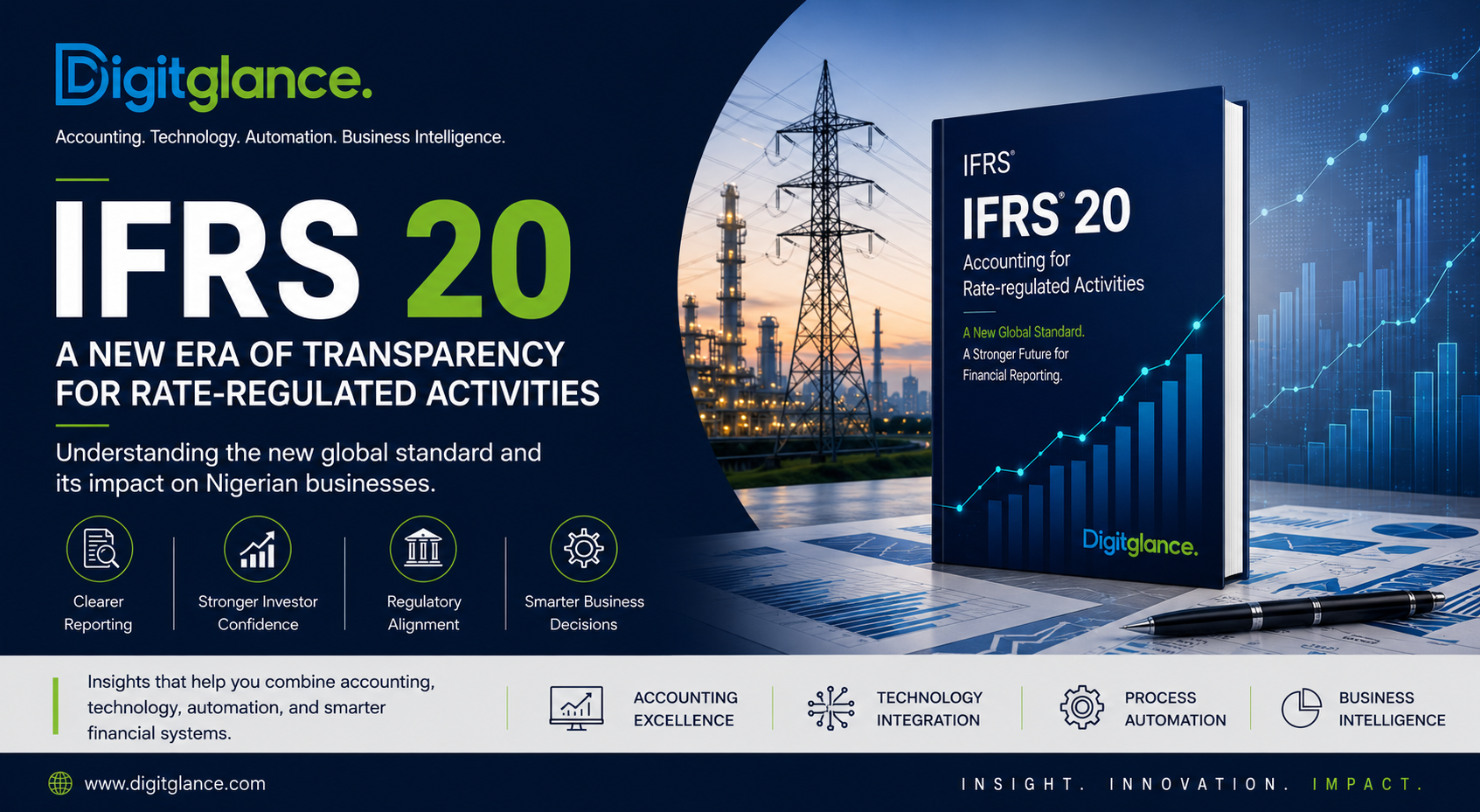
A new global accounting standard for rate-regulated activities will reshape how Nigerian utilities, infrastructure operators, and government-linked businesses report their finances. Here is what IFRS 20 changes, which sectors it affects, and the 2026–2029 readiness path your finance team should start now.
If you run a Nigerian electricity distribution company, a gas utility, a water board, or any business whose prices are set or approved by a regulator, the next four years will change how your books look.
The International Accounting Standards Board has finalised IFRS 20, the new global standard for rate-regulated activities. It moves the accounting treatment of regulatory shortfalls, tariff recoveries, and government interventions out of the footnotes and into the heart of the financial statements. Boards, lenders, investors, and regulators will read your numbers differently from 2029 onwards.
This article explains what IFRS 20 is, why it matters specifically for Nigerian businesses, which sectors will feel it most, and what your finance team should be doing now to be ready.
TL;DR
IFRS 20 affects every business that operates under a regulator-approved pricing framework. For Nigeria, that means electricity DisCos, gas utilities, water corporations, and infrastructure concessions. Future tariff recoveries will appear on the balance sheet for the first time. Companies that begin scope review in 2026 will reach the 2029 first-reporting deadline calmly. The ones that wait until 2028 will be in crisis mode.
What IFRS 20 actually is
IFRS 20 covers what accountants call “rate-regulated activities.” The simplest way to describe it: any business where a government regulator approves the prices you charge customers, and where that regulator allows you to recover specific costs through future price adjustments.
Electricity distribution is the cleanest example. A Nigerian DisCo cannot decide what to charge its customers. The Nigerian Electricity Regulatory Commission sets the tariff. When fuel costs rise or the naira moves, the DisCo absorbs the shortfall in the short term. The regulator then approves a tariff adjustment that lets the DisCo recover the shortfall through future bills.
Under the old rules, that future recovery was invisible to most investors, it lived in a footnote. Under IFRS 20, it becomes a regulatory asset on the balance sheet, measured and disclosed alongside every other asset the business owns.
The same principle applies to gas utilities, water corporations, telecom infrastructure operators, and railway and toll-road concessions. Anywhere a regulator approves prices and permits cost recovery through future tariffs, IFRS 20 changes how the numbers are presented.
Why the IASB built this standard
Before IFRS 20, the global picture was a mess. Some regulated companies in Canada and India recognised regulatory balances on their balance sheets. Others in Europe and Africa did not. Investors trying to compare a UK water utility against a Nigerian DisCo were comparing two different things in two different ways.
The IASB stepped in for four reasons that matter directly to Nigerian businesses:
- Transparency. Regulatory shortfalls and recoveries become visible on the face of the financial statements, not buried in narrative disclosures.
- Comparability. A Nigerian gas utility can now be valued on the same basis as a Brazilian or Indonesian gas utility. That matters when foreign capital is making allocation decisions.
- Investor confidence. Predictable future revenues from approved tariffs translate into more reliable valuations, which translates into easier access to long-term financing.
- Audit consistency. Auditors stop debating whether a balance should be recognised. The standard tells them.
Which Nigerian sectors will feel it most
Not every Nigerian business needs to think about IFRS 20. Most SMEs do not operate under any kind of regulator-approved pricing framework. They can keep filing under the IFRS for SMEs framework they already use and ignore IFRS 20 entirely.
For the businesses that do fall in scope, the impact varies by sector.
Electricity distribution and generation companieswill feel the largest impact. Nigeria's eleven DisCos and the GenCos all operate under NERC tariff frameworks. They have spent years carrying tariff shortfalls, FX-related recovery gaps, and fuel subsidy adjustments that have lived in disclosure notes. Under IFRS 20, those balances move onto the balance sheet.
Gas and water utilities sit close behind. Nigerian gas distribution and supply businesses operate under similar tariff approval frameworks. State water corporations, where they prepare audited IFRS financial statements at all, will need to address the same recognition questions.
Infrastructure concessions sit in the moderate-impact category. Toll-road operators, port concessionaires, and rail operators whose revenues are tied to regulator-approved pricing schedules will need to evaluate whether their contracts fall within the IFRS 20 scope.
Telecoms and manufacturing sit at the bottom of the impact scale. Most pricing in these sectors is set by competitive markets, not by regulators. Only a narrow set of telecom infrastructure concessions and licence-fee arrangements would trigger IFRS 20 considerations.
What changes on your balance sheet
The most visible change happens on the balance sheet. The diagram below shows what a regulated Nigerian business will look like before and after IFRS 20.
Before · today
Buried in a footnote
- • ₦40bn tariff shortfall in narrative notes
- • Invisible to most investors
- • Inconsistent disclosure format
- • Hard to compare or value
After · IFRS 20
On the balance sheet
- • ₦40bn recognised as a regulatory asset
- • Measured and disclosed in full
- • Globally comparable presentation
- • Smoother, defensible earnings
Three changes do most of the work.
Balance sheet
New regulatory assets and liabilities appear. A DisCo that has been carrying a ₦40 billion tariff shortfall will recognise that recoverable amount as an asset. A company that has over-recovered will recognise the offsetting liability. The balance sheet finally tells the truth that the disclosure notes have been telling for years.
Income statement
Revenue recognition becomes more closely matched to the costs that drive future tariff recoveries. The result, in most cases, is smoother reported earnings. The boom-and-bust cycle that regulated businesses sometimes show, where one year's loss is followed by an outsized recovery the next year, gets evened out across periods.
Cash flow and disclosures
Cash flow forecasts become easier to defend to lenders because the underlying regulatory mechanism is now visible. Disclosures expand: companies will need to explain regulatory assumptions, tariff approval timelines, and the risks that could disrupt cost recovery. Auditors will look at these disclosures closely.
What changes for investors, banks, and lenders
Capital follows transparency. The single biggest commercial upside of IFRS 20 for Nigerian regulated businesses is that it makes them easier to fund.
A foreign infrastructure fund looking at a Nigerian utility today struggles to understand the future revenue model. Tariff shortfalls show up as narrative footnotes, often inconsistent in format. Under IFRS 20, the same fund sees a measured regulatory asset, a documented recovery timeline, and a comparable presentation to every other utility it tracks worldwide. The cost of capital falls.
2029
First audited IFRS 20 reporting year
11
Nigerian DisCos squarely in scope
Lower
Cost of capital for transparent utilities
4 yrs
From scope review to first reporting
Nigerian banks lending to DisCos, gas utilities, and infrastructure operators will reassess credit risk based on the same balance-sheet view. Companies with strong regulator-approved recovery positions will be easier to lend to. Companies with weak documentation of their regulatory arrangements will find the opposite. Long-term project finance becomes easier to structure because the recoverable cash flows are now visible and auditable.
Where Nigerian companies will struggle
Implementation will not be easy. Three structural weaknesses inside many Nigerian regulated businesses will surface during the transition.
Data systems are not ready
Many regulated Nigerian companies still run their finance functions on disconnected spreadsheets, legacy ERPs, and manual reconciliation between operational and financial systems. IFRS 20 requires accurate, auditable data on every regulator-approved arrangement, every tariff adjustment, every shortfall, and every recovery. That data needs to be queryable, not buried in shared inboxes.
Technical expertise is thin
IFRS 20 is a specialist standard. The number of Nigerian accountants and auditors with deep technical knowledge of rate-regulated activities is small. Training programmes will need to scale fast, or companies will need to bring in external advisors for the first two reporting cycles.
Estimating recoverable balances is hard
Recognising a regulatory asset requires confidence that the underlying recovery will actually happen. In Nigeria, where tariff approvals can be delayed, partially granted, or politically contested, that estimate carries real uncertainty. Companies will need defensible models for measuring recoverable amounts, and they will need to disclose the assumptions behind them honestly.
Watch out
The earliest first-reporting year for IFRS 20 in most jurisdictions is 2029. That sounds far away. It is not. Companies that wait until 2028 to begin will be in crisis mode. The right starting point is 2026.
When to start: the 2026–2029 readiness path
Each phase below sets up the one that follows. Companies that compress the timeline pay for it in audit qualifications and stakeholder confidence.
Phase 1 · 2026
Scope review
Map every regulator-approved arrangement and recovery mechanism.
Phase 2 · 2027
Gap analysis
Compare current policies and systems against IFRS 20. Build the plan.
Phase 3 · 2028
Parallel run
Dual reporting for a full year. Train the team. Walk auditors through it.
Phase 4 · 2029
Full reporting
First audited IFRS 20 statements. Pressure-tested. No surprises.
Phase 1 (2026): Scope review
Identify every regulator-approved arrangement the business operates under. Map the tariff frameworks, the approval bodies, the recovery mechanisms, and any historical shortfalls or over-recoveries. The output is a complete inventory of in-scope activities.
Phase 2 (2027): Gap analysis
Compare current accounting policies and systems against what IFRS 20 will require. Identify the data gaps, the policy gaps, the system gaps, and the training gaps. Build a project plan with budget, owners, and milestones.
Phase 3 (2028): Parallel run
Run dual reporting. Maintain the current GAAP basis alongside an IFRS 20 simulation for the full financial year. Strengthen internal controls. Train the team. Walk auditors through your approach before the live year begins.
Phase 4 (2029): Full reporting
First audited IFRS 20 financial statements. Investor presentations updated. Lender covenants reviewed. By the time you publish, the model has been pressure-tested for twelve months. There are no surprises.
What your finance team should do this quarter
Eight concrete actions for the next ninety days, in order:
- Document every regulator-approved arrangement. Pull the tariff approvals, the recovery letters, the FX adjustment correspondence. Put it in one folder.
- Quantify the in-scope balances. Calculate, in naira, the recoverable shortfalls and over-recoveries that have built up. This is your starting balance-sheet impact.
- Audit your accounting systems. Identify which transactions, balances, and disclosures your current ERP and accounting tools can produce, and which gaps you will need to close.
- Start the conversation with your auditor. Get their initial view on your scope, your data, and your timeline. Audit firms are staffing up for IFRS 20. Engage early.
- Build a working scenario model. Project what the balance sheet, income statement, and cash flow will look like under IFRS 20 versus the current basis. Share with the board.
- Brief your lenders. Banks and DFIs do not like surprises. A short, clear briefing on how your financials will look post-IFRS 20 protects covenants and credit ratings.
- Train your team. Start with the head of finance, the financial reporting lead, and the regulatory affairs lead. Build internal capacity before you rely on external advisors.
- Refresh your investor communication. Update your IR materials with a short explainer on what IFRS 20 means for your numbers. Get ahead of the questions.
Where Digitglance fits
DigitGlance builds business technology for how Nigerian companies actually operate. For regulated businesses preparing for IFRS 20, three parts of the DigitGlance ecosystem matter most.
- Accounting Suite. Captures every transaction with the audit trail, classification, and reporting structure that IFRS 20 reporting demands, built in Nigeria, for Nigerian regulatory practice.
- AI tools, in plain English. AuditReady NG, FinReport AI, and TaxDesk NG help finance teams produce defensible schedules, narrative disclosures, and scenario forecasts without buying enterprise software priced in dollars.
- Professional services. Delivered with Ade Fajemisin and Associates in Lagos, audit-firm-grade advisory on regulatory exposure, system gap analysis, and IFRS implementation timelines.
The shift to IFRS 20 is one part of a broader move toward intelligent financial systems for Nigerian businesses: real-time reporting, audit-ready documentation, automated reconciliation, and forecasting tools that produce defensible numbers. The companies that invest in these systems now will be ready not only for IFRS 20, but for whatever the next standard brings.
The takeaway
IFRS 20 is a compliance event on paper. In practice, it is a business transformation moment. The companies that start in 2026 will reach 2029 with confidence and a stronger balance sheet to show for it. The companies that wait will spend that year explaining audit qualifications to their boards. Start the conversation early, the next four years are shorter than they look.
Further reading and sources
- IFRS Foundation, “IFRS Accounting Standard for Rate-regulated Activities,” ifrs.org publications and project updates.
- International Accounting Standards Board (IASB), effects analysis for the rate-regulated activities project.
- Nigerian Electricity Regulatory Commission, Multi-Year Tariff Order frameworks and tariff adjustment correspondence.
- Big Four IFRS 20 technical bulletins (KPMG, EY, PwC, Deloitte).
- DigitGlance research notes on Nigerian regulated-sector financial reporting practice.
Track your books, file VAT, and get paid faster.
DigitGlance Trade handles invoicing, POS, VAT, inventory, and reports so you can focus on running the business, not on chasing receipts.